
Monday, November 1, 2010

Cook's Illustrated Pissaladière-Onion, Olive & Anchovy Tart

I was flipping through a pile of old Cook's Illustrated at my sister's. Among other reason that make Cook's Illustrated superior to other culinary publications is the fact that there is always a recipe that you want to make right away. Pissaladière was the one that I ran into. Pissaladière is a simple french staple that can be served for simple dinner, brunch, or a wine paring event. To me it feels that the dish should be accompanied by a vegetable or a green, which, in my case, was a bed of arugula with shaved Pecorino and thin slices of the celery root. Simply blanched green beans or lightly roasted carrots should also compliment the salty and buttery taste of Pissaladière well. A glass of local 2007 Syrah from Delaplane Cellars is was a great pairing. 
Dough
2 cups of bread flour and about 1/2 cup for rolling and shaping
1 teaspoon instant yeast
1 teaspoon Kosher salt
1 tablespoon olive oil and another 2 teaspoons of olive oil for brushing and shaping the dough
1/2 cup hot water mixed with 1/2 cup room temperature water
Mix all dry ingredients with oil. Pour in water in three batches mixing gently until the dough forms a ball.
With well floured hands transfer the dough into a floured board and knead for 3-5 minutes until the dough becomes smooth.
Oil a large bowl or a 32 ounce (minimum) tupperware. Place the dough in a bowl/tupperware, roll around once to cover all of the dough with oil, and cover with a plastic wrap/top. Let the dough rise in a draft free place for an hour or leave it overnight in a refrigerator.
Onions
2 tablespoons olive oil from anchovies
4 large Vidalia onions, diced into 1/2 inc pieces (4 cups)
1/2 teaspoon Kosher salt
1 teaspoon brandy/cognac
1 tablespoon water
Heat the oil on a medium heat in a non-stick or cast iron pan. 
Add onions and salt. Cook for 10 minutes until onions start to brown.
Add brandy/cognac and let the alcohol evaporate. Lower the heat, add water, and cook stirring every 5 minutes for another 20 minutes until onions become golden brown.

the steps of Delaplane Cellars http://www.delaplanecellars.com/
Toppings
1/2 cup black pitted olives, roughly chopped
8 anchovy fillets packed in oil, roughly chopped plus 9-10 additional anchovy fillets
thinly sliced green onions (optional)
Preheat the oven to 500F.
Once the dough doubles, with well oiled hands remove the from the container, and divide into 2 equal parts, leaving one in a container while you are shaping the other. 
Shape the dough by pulling and folding the edges of the dough ball in the center. Imagine you are folding chamomile petals.
Flip the dough seam side down and start stretching it by pressing and pulling it with a palm of one hand while holding the other end. Add flour if the dough sticks. Lay on a baking sheet or a pizza stone sprinkled with corn meal or lined with a parchment papper. Repeat with the second piece of dough.
Brush the dough with olive oil. 
Scatter onions, olives, chopped and anchovies. Layer anchovy fillets.
Bake until edges of the dough become golden brown about 15-17 minutes.
Cool and sprinkle with green onions.




Tuesday, October 12, 2010

Elements of the weekend: sustainable eating and birthday pear tart

In the past couple year, I have been increasingly using local seasonal produce from community supported agriculture (CSA) ran by the Bull Run Mountain Farm. Leigh Hauter, the owner of the farm, is one of the most wonderful CSA providers in D.C. area. He always delivers exceptional organic fruits and vegetables along with fresh eggs and honey. Few times a season, shareholders also can order 5-pounds of raw Cheddar or Colby cheese, and visit the Farm for a shareholders party, cider pressing, and gleaning. I could not miss an opportunity to make some fresh cider. Here is the video of me pressing cider and links to the farms' websites.
Information on CSA http://bullrunfarm.com/
Website of the dairy farm http://www.farmsteadfresh.com/

In addition to the traditional apple cider, we made some pear cider, which was absolutely divine. I saved few pears to make an almond pear tart for my dear friend Amina’s birthday.
Almond-pear tart
Tart shell:
1 1/2 cups all-purpose flour
¼ cup agave
1/4 teaspoon salt
9 tablespoons of frozen unsalted butter, cut into small cubes or grated
1 large egg yolk
Put the flour, sugar and salt in the bowl and mix using 2 forks until the flour mixture mixes with butter forming coarse meal the size of oatmeal. Mix in the yolk until it blends in forming clumps. Turn the dough on the counter and gently form a ball, then knead carefully. Wrap the dough in plastic and refrigerate for couple hours.

After the dough chilled for 2 hours move it to well-floured surface. I am lucky to have stone countertop that keeps the dough cool longer. Butter an 8-inch tart pan with a removable bottom. Lift the dough to prevent sticking. Roll on half of the dough on the rolling pin and move to the pan. Press the dough carefully intol the pan sealing the edges. If the dough is bigger than a pan press the extra dough into the edges to make them firmer. Generously pierce the crust with fork.

Cover the crust tightly with non-stick aluminum foil and freeze for at least an hour.

Preheat the oven to 375°F and bake the crust for 25 minutes on the middle rack. Remove the foil and bake the crust for another 5 minutes. Cool the crust on a rack.

Filing:
2 cups dessert wine
½ cup agave
1 1/2 tablespoons fresh lemon juice
3 firm but ripe pears, peeled, cut in a half vertically, and cored

1 ½ cup almond meal
2 tablespoon all purpose flour
1 ounce agave
1 ½ stick room temperature butter
2 large eggs
1 teaspoons brandy
1 teaspoon almond extract
Powdered sugar (optional)
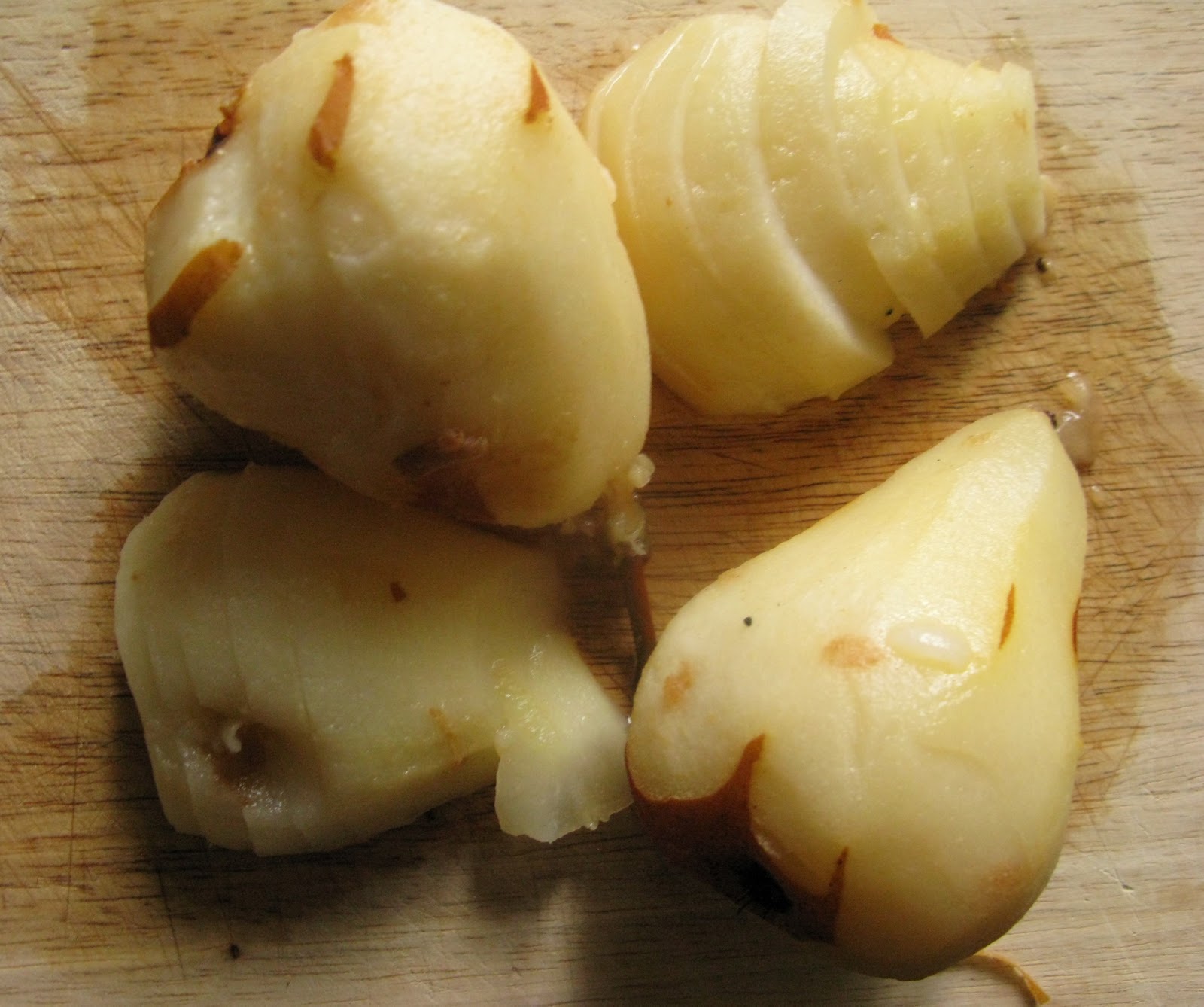
Bring wine, agave, and lemon juice to simmer. Add pears and cover the pot. Simmer for 15-20 minutes until pears look soft and translucent. Cool pears in syrup (reserve the syrup to top vanilla ice cream) Once pears are cool, cut the pear halves into ½ inch thick half rounds keeping the shape of half a pear together.

Mix almond meal, flour, and butter. Slowly mix in agave, eggs, brandy, and almond extract.

Spread the filling evenly in the crust. Carefully lift the pear halves using a large knife as a shelf and place in the filling so the top part of the pear point in the center. Gently press the pear on an angle, so the pieces will fan out.

Bake the tart for 55 minutes or until a toothpick comes out clean. Cool tart in the pan on rack. Sift powdered sugar the bottom of the shell, and serve.

Tuesday, September 28, 2010

Indian vegetarian food from a Kazakh kitchen


For the longest time, I had a big aversion to cilantro and its relative, lovage, which is used as cilantro in all of Central Asia.  Both herbs tasted like soap and I could not come up with a better way to ruin a dish than to add cilantro or lovage to it.  Fortunately, through years of dedicated practice (riiiight), I came to see cilantro for what it is - a lovely way to add brightness to a dish.  Now, I can't imagine either Baigan Bharta or Chana Masala in this post without a generous handful of cilantro. It adds freshness to cooked spices, bringing them out of the doldrums and back into life.

The Chana Masala, courtesy of Orangette is a staple in my house, a perfect easy meal pulled together from pantry staples and trusted spices, comfort at the end of the day.  The Baigan Bharta has long been an obsession, but I disliked the greasy version often found in take-out.  Fortunately, with the eggplant season still in full swing, I've had plenty of time to experiment with multiple recipes and find the one that I liked.  My mom especially loves this dish and has been a content Kazakh tucking into Indian vegetarian food.

Baigan Bharta
1 medium - large eggplant
1 medium tomato
2 cloves of garlic
1 medium onion
1/2 inch knob of ginger
1 medium jalapeno or 1/2 teaspoon of cayenne
2 - 3 tablespoons of olive oil or ghee
1/2 teaspoon of black mustard seeds
1/2 teaspoon of cumin seeds
1/2 teaspoon of ground coriander
1/2 teaspoon of turmeric
1/2 teaspoon of chili powder
1 teaspoon of garam masala
Sale to taste and a generous handful of cilantro to finish

Preheat the oven to 400 degrees.  Wash the eggplant and prick it all over with a fork or a tip of a knife. Roast it (I like lining the baking sheet with foil for easy clean-up) for 45 minutes or until it is soft and sort of collapses into itself.

Meanwhile, heat up a large deep skillet with a couple of tablespoons of oil or ghee over low-medium heat.  Chop the onion and tomato into cubes, finely chop garlic, ginger and jalapeno, if using.  Drop the onion in the pan and fry until it starts turning golden, then add the garlic, ginger, and jalapeno.  Fry for another minute or so, until your kitchen starts smelling like the promise of dinner.  Add another tablespoon of oil and fry the spices for a minute also, moving them around, so that they do not burn until fragrant.  Drop in the tomato, letting it release its juice for a couple of minutes.  Add a couple tablespoons of water, cover, and simmer on low heat for 5-10 minutes to let flavors become friendly.  

Once the eggplant has reached its collapsed state, carefully take it out and let cool, so that you can handle it.  Once cooled, split it in half and scoop out the flesh with a large spoon onto a big cutting board.  Run your knife through the seedy flesh, further breaking down the fibers.  Note how strong eggplant skin is.

Add the eggplant to the pan, mix well and let cook for another 10 minutes under the lid.  Season well with salt and stir in plenty of cilantro.  If you hate cilantro, try a bit of mint or green onion.  Serve with rice and Chana Masala.


Tuesday, September 14, 2010

Vareniki, granola, and apple bread

Our mom is in the States for 3 months. She spends most of her time in NYC, so I don’t get as many goodies as my sister does. During this week when she was visiting, I tried to squeeze in as many dishes that we wanted to exchange on the menu. One of the things that I miss the most about mom’s cooking, is hand-rolled pasta dough and 10,000 dishes she uses it for. We made a slightly gourmet version of vareniki, traditional Ukrainian ravioli, apple bread, and granola. I made some tweaks to the apple bread recipe from smittenkitchen.com and staple granola recipe substituting sugar for agave.
Apple bread: substitute a cup of oil and sugar for ½ cup of oil and ½ of agave.

Granola:
4 cups of regular oats
generous pinch of salt
1/3 cup of agave
1/3 cup of vegetable oil
3 cups of assorted chopped nuts, seeds, and dry fruits. I used walnuts, sunflower seeds, dried apricots, and raisins.
Bring the oven to 300F. Mix oats, salt, agave, and oil.Spread the mixture evenly on a cookie sheet or non-alumni baking sheet. When using alumni baking sheet cover it with parchment paper, because aluminum might alter the taste of some foods.
Bake for 1 hour. Mix in nut, seed, and fruit mixture and bake for another 15 minutes. Cool on a wire rack. Refrigerate in a closed container for up to 2 weeks.
Dough
1.5 – 2 cups of white flour
pinch of salt
1 egg
1 cup (at the most) of tepid water
Mix 1.5 cup of flour and salt. Make an indentation in the flour mixture and add the egg. Mix in the egg breaking it gently. Start adding water a little bit at the time and mix it in. Add enough water to form a dough. Knead the dough on a floured surface until it becomes soft and elastic adding flour and water if needed for about 3-5 minutes. Cover the dough with a bowl or plastic wrap and let it rest for 10-15 minutes.
Uncover the dough and knead for another 3-5 minutes. The dough should be very easy to
work with and should not be sticky. Split the dough into 2 balls. Cover one, while you roll out the other into a 1/6 inch thick disk.
Cut into circles of dough using a cookie cutter or a glass. Cover the sheets with a towel to prevent drying out.
Filling
2 medium size yellow squash
2 medium size russet potatoes, skins removed
salt/pepper to taste
olive oil
Preheat the oven to 400F. Split squashes in a half forming boats. Brush squash with olive oil, sprinkle salt/pepper, and bake for 30 minutes. Bring a pot of salted water and boil potatoes for 20 minutes.
Scoop out the flesh of squash, strain potatoes, and mash with a little olive oil until smooth. Using immersion blender makes this a little easier. Adjust salt and pepper.
Assembling
Take a dough circle, place about a teaspoon of filling on one side and close the pocket. Place vareniki on a floured surface until you assemble all of them.
Bring a large pot of salted water to boil and carefully drop vareniki. Boil on high heat until vareniki start floating on surface. Scoop out carefully.
Eat right away with a little butter, pesto, or any other light and herb sauce.